
The MCP ecosystem by the numbers
MCP is the fastest-adopted protocol in AI's history. But the ecosystem it created is built for developers, not agents. The infrastructure agents actually need doesn't exist yet.

Anthropic released the Model Context Protocol in November 2024. MCP is a standard that lets AI agents use external tools. An agent that needs to query a database, read a file, or call an API does it through an MCP server. Each server is a connector: one piece of software that gives an agent access to one capability. A GitHub MCP server lets agents work with repositories. A Postgres MCP server lets them query databases. A Stripe MCP server lets them process payments.
Fourteen months later, there are 20,000 of these connectors on GitHub, 31 million weekly NPM downloads, and $73 million in venture capital for MCP-native companies[1].
I counted 1,450 curated servers from the largest community index[2] and cross-referenced them with Astrix Security’s analysis of 5,200 implementations[3]. The growth numbers aren’t the story. The composition is.
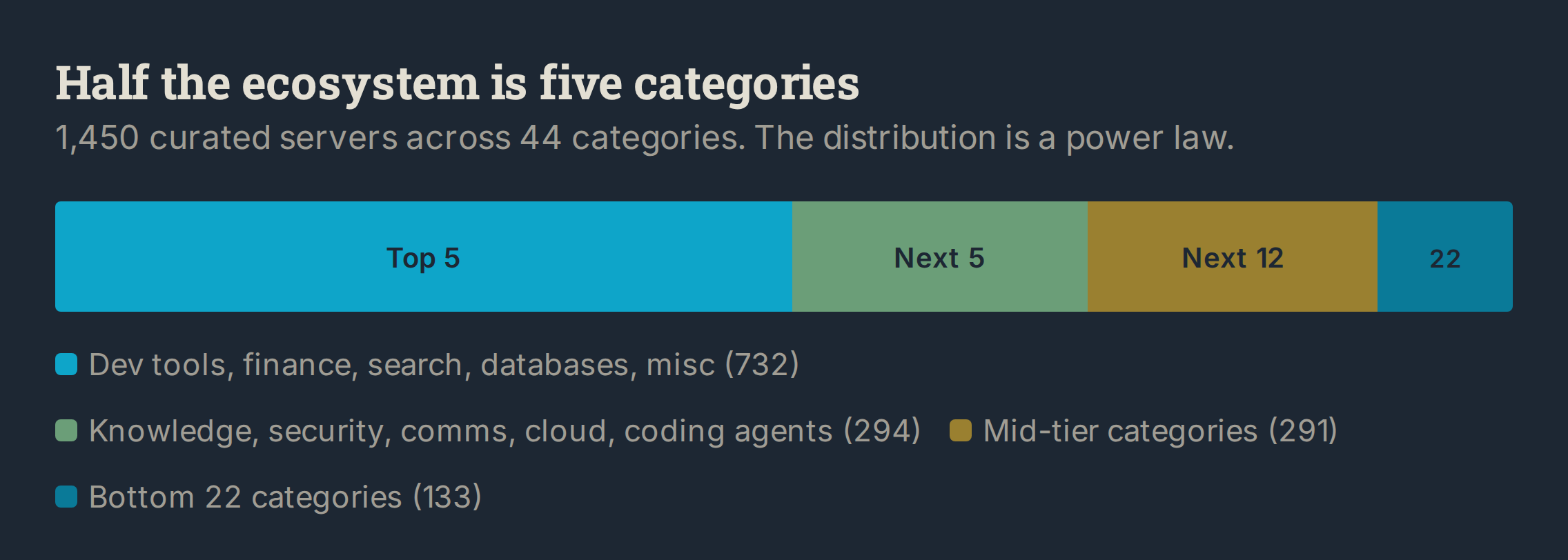
Developer tools, databases, and search make up a third of the ecosystem by themselves. These are the categories a developer reaches for when wiring an AI assistant into an existing workflow. Practitioners solving today’s problems, not infrastructure teams building for what comes next.
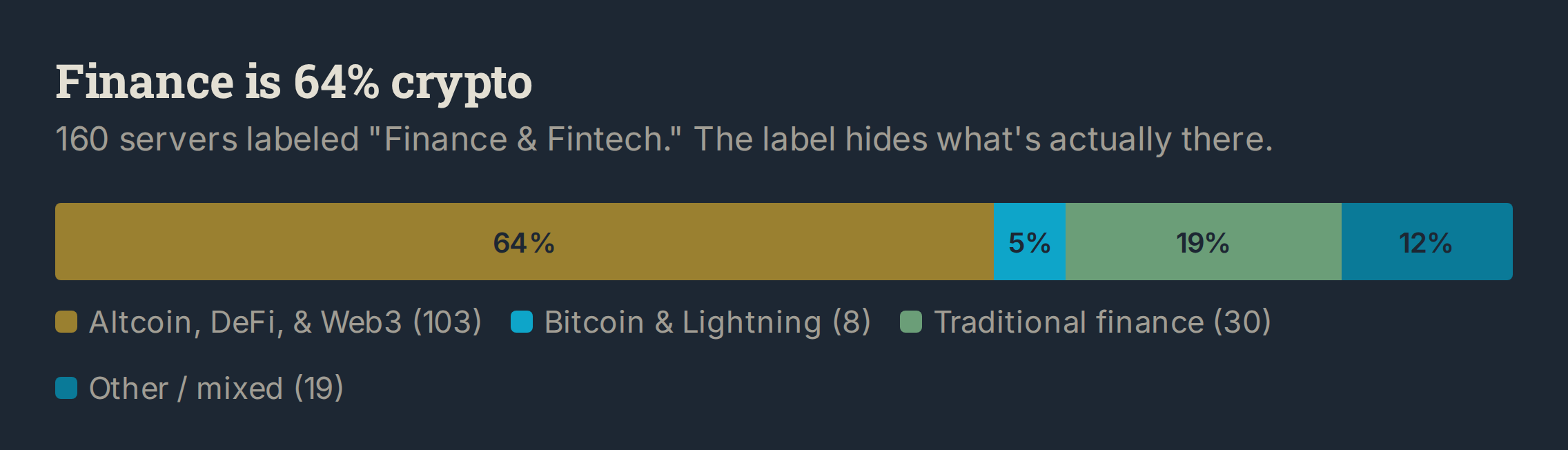
The second-largest category in the ecosystem isn’t fintech infrastructure. It’s crypto developers building for themselves. Of 160 finance servers, 103 are altcoin, DeFi, and Web3. Trading bots, DEX integrations, rug pull detectors, prediction markets. Bitcoin and Lightning account for 8, and those look fundamentally different: Alby wallets, LNbits, L402 agent payment rails. Protocol-level infrastructure, not token speculation. Traditional finance (stocks, banking, accounting) is 30 servers. The “fintech” label is doing a lot of work.
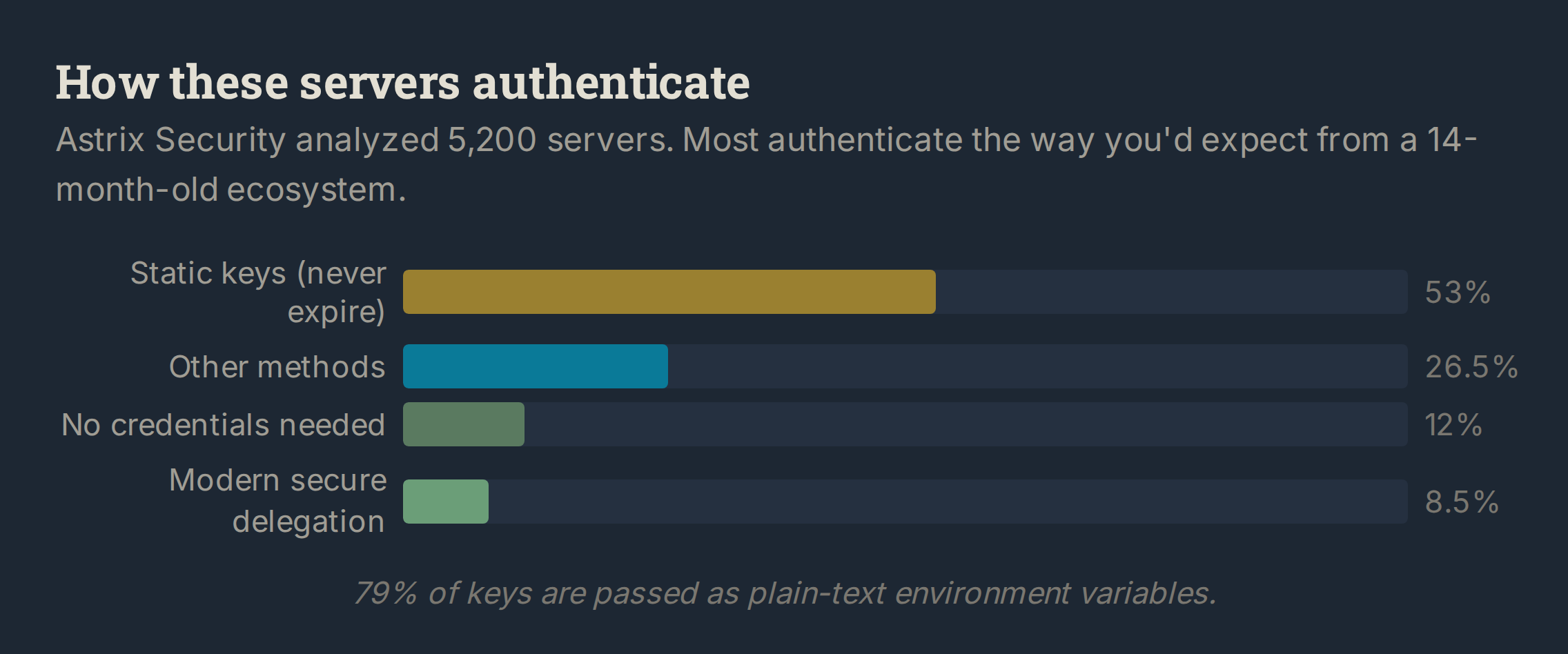
More than half of all servers that need credentials use static keys. Tokens that never expire, can’t be scoped to a specific task, and sit in plain text on developer machines. The modern secure alternative represents 8.5% of the ecosystem. Meanwhile, enterprises report that non-human identities outnumber human ones 82 to 1[4].
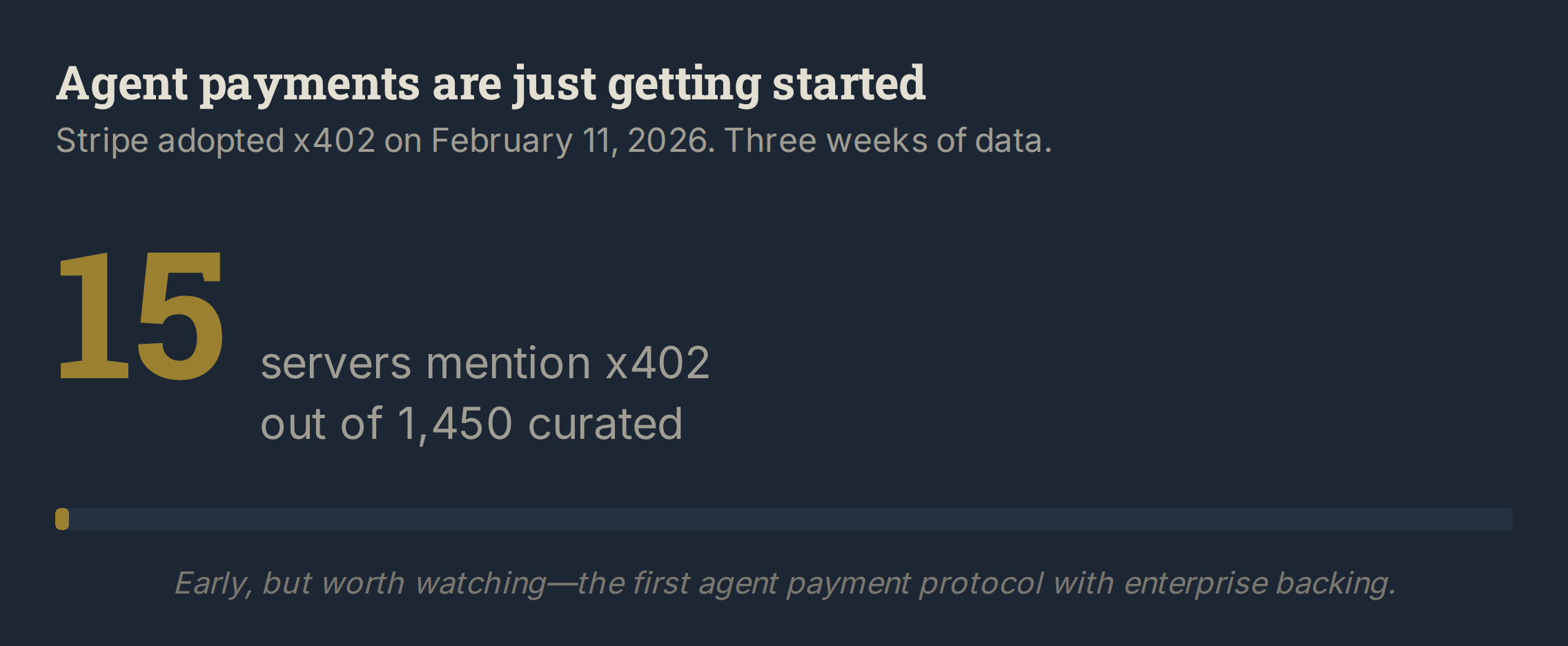
Fifteen servers three weeks after Stripe’s adoption. Too early to read as a verdict. x402 is a month old in its current form. What the number tells you is where the ecosystem is right now: agent payments are a greenfield, not a market. Coinbase launched x402 in May 2025, but Stripe’s entry in February 2026 is what gives it enterprise credibility. The next count will be the interesting one.
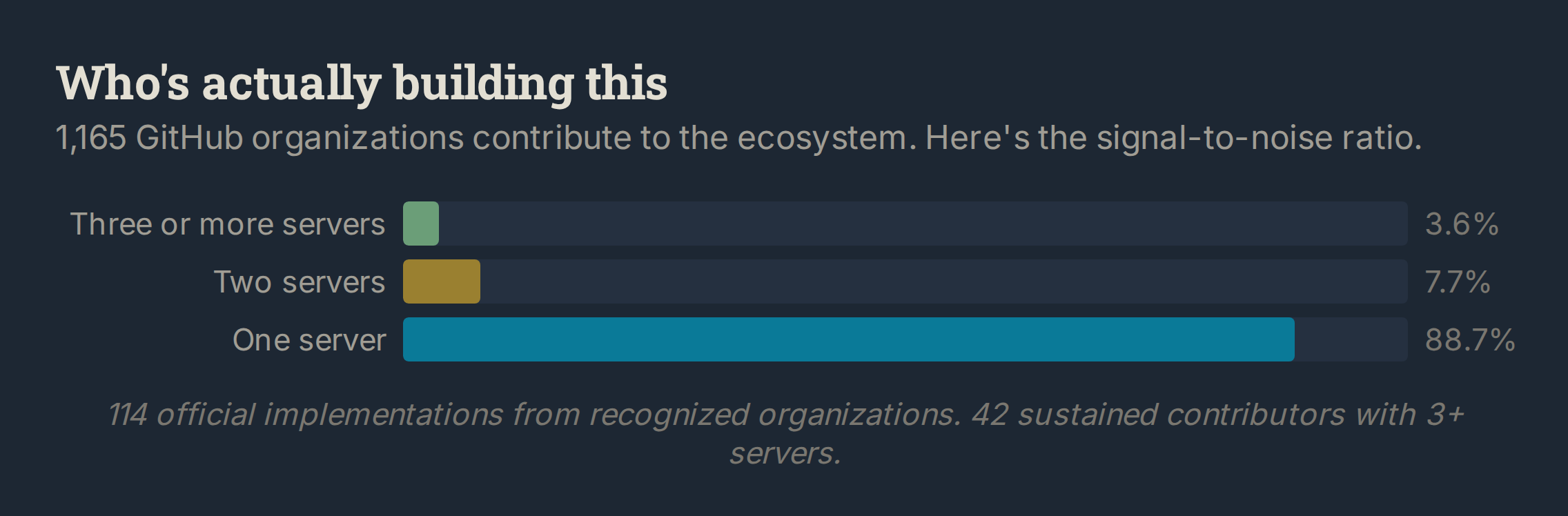
Of 1,165 contributing organizations, 114 are official implementations from companies like Anthropic, Cloudflare, AWS, Hashicorp, Redis, and Pulumi. Another 42 orgs have shipped three or more servers. Sustained investment, not a weekend experiment. Together, these groups account for about 23% of the curated ecosystem. The remaining 77% comes from organizations that contributed once or twice. Normal for open-source adoption curves. It also means the long-term maintenance burden falls on a small core.
What the numbers say
MCP adoption is real. Twenty thousand connectors in fourteen months, backed by Anthropic, AWS, Cloudflare, Hashicorp. But the ecosystem is shaped by what developers need today, not what agents will need to operate on their own. Developer tools, databases, and search are the core. Payments, identity, and discovery are either empty or three weeks old.
The credential story is a side effect of speed. Anthropic’s early examples used static keys. Developers followed the pattern. Now 53% of the ecosystem authenticates that way, and 88.7% of contributors already moved on to the next thing. Not a design choice. Inertia.
Bitcoin and Lightning are a different animal from the rest of the finance category. Eight servers, all infrastructure. Wallets, payment rails, protocol tooling. Nobody designed Bitcoin for AI agents, but its properties (permissionless, programmable, no identity requirements) mean it doesn’t need to be retrofitted for them either. L402 predates x402 by years. That head start matters.
MCP is the first real infrastructure layer for agents, and it’s built by developers plugging AI into their existing work. That explains the shape of the ecosystem. The pieces agents need to operate on their own (finding services, proving identity, paying for access) are a different problem entirely. Different builders will solve them, with different incentives, on a different timeline.
Glama, “The State of MCP in 2025”, December 2025.↩︎
punkpeye/awesome-mcp-servers GitHub repository, counted March 2026.↩︎
Astrix Security, “State of MCP Server Security 2025”, ~February 2026. 5,200 unique open-source MCP server implementations analyzed.↩︎
CyberArk, “2025 Identity Security Threat Landscape Report”, October 2025.↩︎